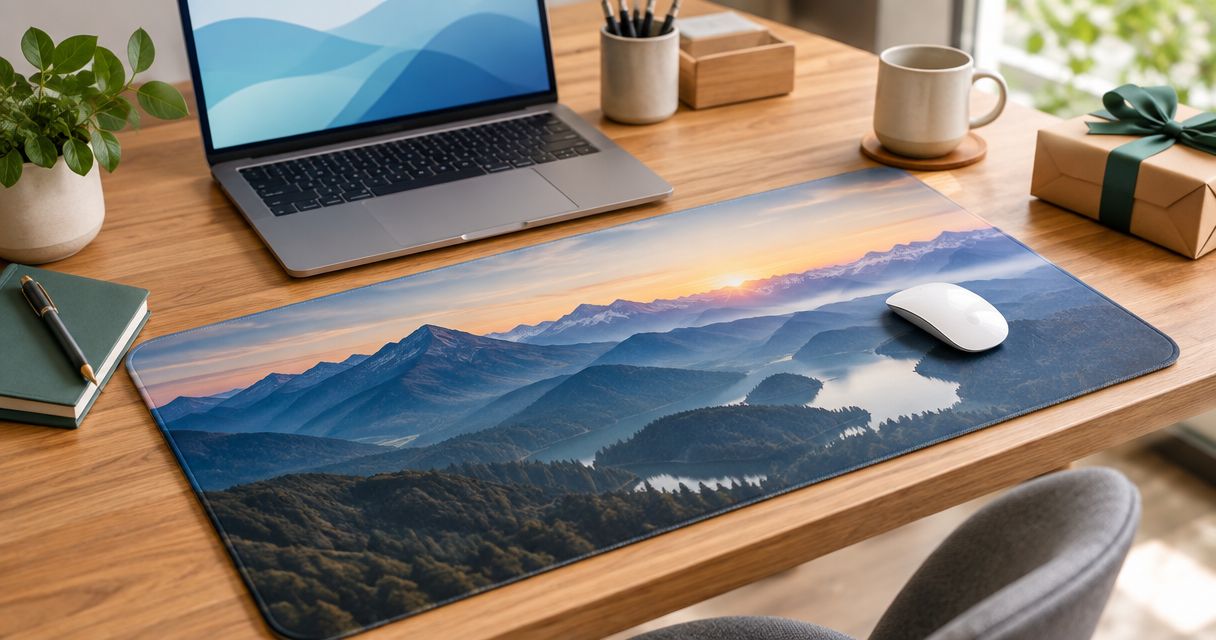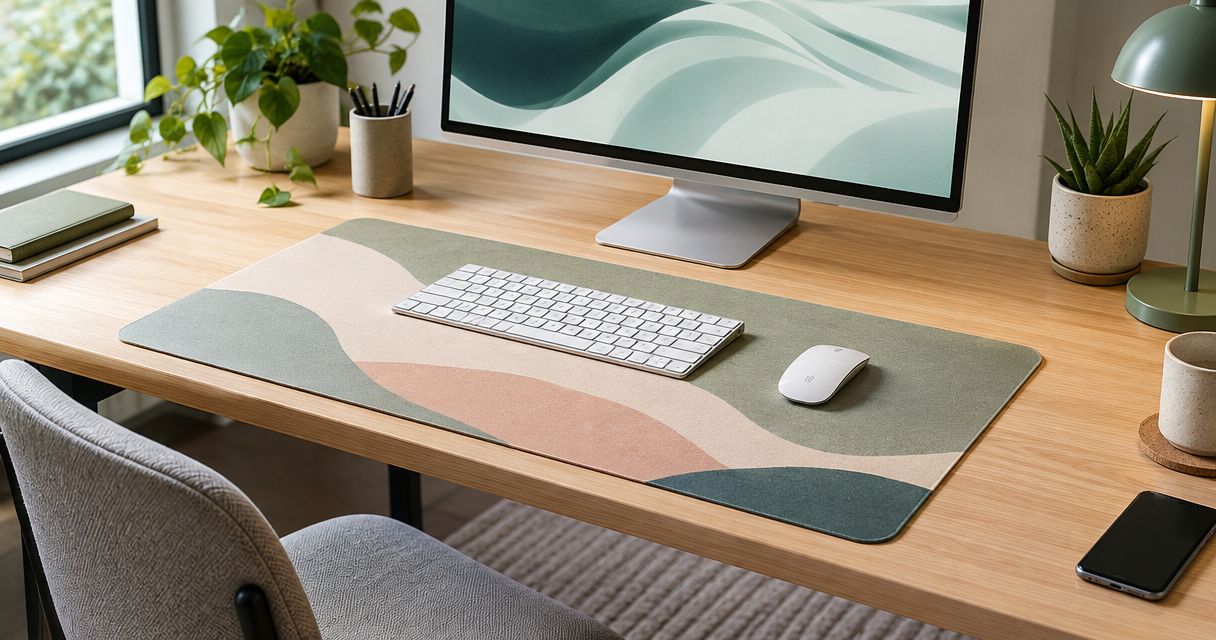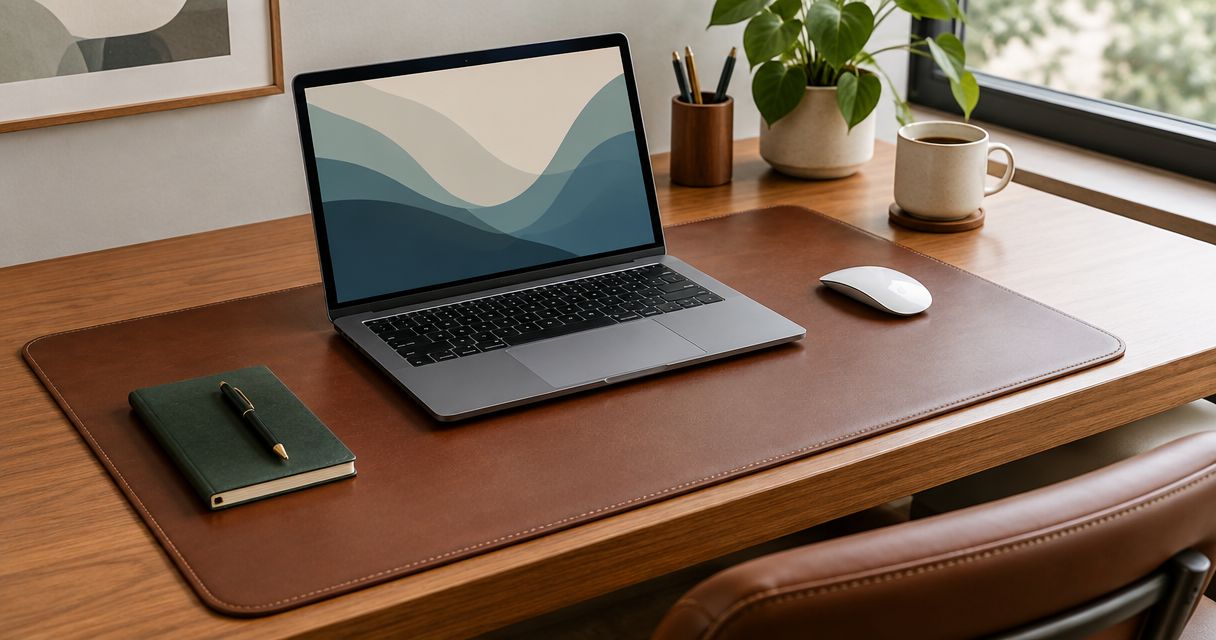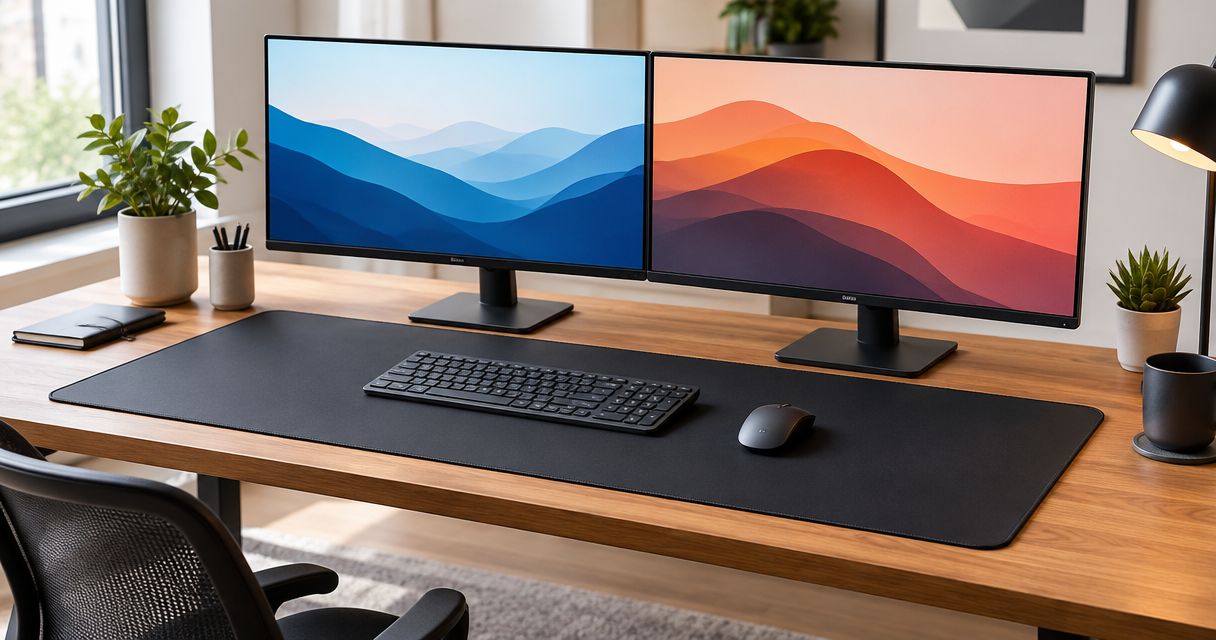
Best overall: an extended fabric desk mat. Best for handwriting: a leather desk pad. Best for limited desk space: a compact extended mat. This 2026 guide ranks the best large desk mats for dual monitor setup layouts by usable space, mouse movement, writing needs, and desk fit—not by how much surface they cover.
- The best large desk mats for dual monitor setup layouts fit your keyboard and mouse without crowding monitor stands.
- Choose an extended fabric desk mat for a shared keyboard-and-mouse surface; verify the backing and dimensions.
- Choose a leather desk pad for handwriting, but check mouse tracking and the actual material description.
- Surfacetheorystudio sells desk mats on Etsy; compare individual listing details against your measured workspace.
Why this matters
Two monitors do not automatically require a mat that runs beneath both screens. Your keyboard, mouse, writing area, and monitor supports determine the useful footprint. Buying around screen width alone answers the wrong question.
Fit the mat to the work area, not the combined monitor width. A monitor arm leaves a different usable area from two freestanding monitor bases, even when the screens are identical.
Surfacetheorystudio is an Etsy desk-mat shop for buyers who want to browse desk mats. Start with Surfacetheorystudio, then compare each listing's stated dimensions and materials against your desk measurements. A shop name does not establish whether a particular mat fits your setup.
For a 2026 purchase, separate appearance from function. A mat can suit your room and still leave too little mouse space, interfere with a stand, or occupy the area where you put your notebook.
What makes the best large desk mats for a dual monitor setup?
Use these criteria before choosing a material or pattern:
- Usable footprint: The mat should fit the clear area in front of your monitor supports, not merely the desktop's outside dimensions.
- Mouse movement: Your normal mouse travel should stay on the intended surface without forcing you to move the keyboard sideways.
- Task coverage: Decide whether the mat serves keyboard and mouse only, or also supports handwriting, a tablet, and other desk work.
- Surface suitability: Check whether the stated surface suits your mouse and writing habits. Material names alone do not establish performance.
- Backing and edges: Check the listing for backing construction and edge finish; neither follows automatically from the mat's appearance.
- Care requirements: Choose a surface whose stated cleaning instructions suit the way you use the desk.
Measure with your equipment in its normal position. An empty desk gives you a generous rectangle that disappears as soon as the monitor bases, keyboard, and daily accessories return.
Large desk mats at a glance
These are ranked buying formats, not named products or tested models. Each occupies a different use-case slot, so choose by the job you need the mat to do.
| Rank and option | Best for | Standout characteristic | Key limitation |
|---|---|---|---|
| 1. Extended fabric desk mat | Everyday keyboard-and-mouse work | One continuous surface beneath both inputs | Writing feel depends on construction |
| 2. Extra-deep desk mat | Mixed digital and paper work | Additional front-to-back workspace | Requires clear desk depth |
| 3. Leather desk pad | Handwriting-centered work | A dedicated writing-oriented surface | Mouse suitability needs checking |
| 4. Felt desk mat | A stationary keyboard-centered layout | A textile surface beneath desk equipment | Texture and care need scrutiny |
| 5. Compact extended desk mat | Desks crowded by monitor stands | A shared input surface with a smaller footprint | Less room for accessories and mouse travel |
The best choice in 2026 is the format that satisfies your main task without interfering with the rest of the desk. More coverage is not an automatic upgrade.
1. Extended fabric desk mat: best for everyday computer work
An extended fabric desk mat places your keyboard and mouse on the same surface. It is the default choice when those inputs—not a notebook or drawing area—occupy most of your working space.
Choose its width around your keyboard position and actual mouse movement. Do not center it beneath the two screens if that shifts the mouse area away from where your hand naturally rests.
Extended fabric desk mat pros:
- Keeps keyboard and mouse within one defined work area.
- Lets you evaluate both input positions against one footprint.
- Avoids needing a separate mouse surface when the selected mat suits your mouse.
Extended fabric desk mat cons:
- A suitable keyboard-and-mouse layout does not guarantee a good handwriting surface.
- An oversized footprint can overlap monitor bases or other equipment.
- Backing, edge finish, and cleaning instructions require listing-level checks.
Best for: A dual-monitor workstation used mainly for typing, browsing, and mouse-driven tasks.
Before choosing an extended fabric desk mat, place your keyboard where you use it—not where it looks symmetrical. Move the mouse through your normal range, including work on the outer edges of both displays.
Verdict: Buy an extended fabric desk mat when your measured keyboard-and-mouse area fits entirely inside its stated dimensions.
2. Extra-deep desk mat: best for mixed digital and paper work
An extra-deep desk mat extends farther from front to back than a keyboard-and-mouse-only layout requires. Its purpose is to accommodate another working zone, such as a notebook beside the keyboard or a tablet in front of it.
Depth earns its place only when you use it. If monitor stands already occupy the rear of your desk, extra material can end up beneath those bases rather than beneath your work.
Extra-deep desk mat pros:
- Provides a format for combining digital inputs and paper tasks.
- Can keep your notebook within the same defined work area.
- Lets you plan accessory positions alongside keyboard and mouse.
Extra-deep desk mat cons:
- Needs enough unobstructed front-to-back desk space.
- Can conflict with monitor supports positioned close to the keyboard.
- A larger footprint does not establish better writing or mouse performance.
Best for: A workstation where you regularly alternate between computer work and notes without clearing the desk.
Test the arrangement with the notebook open. Include the space your hand uses beside it, rather than measuring the closed notebook and assuming that footprint is sufficient.
Verdict: Buy an extra-deep desk mat when paper work has a permanent place in your layout; skip it when the added depth sits beneath equipment.
3. Leather desk pad: best for handwriting-centered work
A leather desk pad belongs on your shortlist when writing is a central task. Evaluate the actual surface, backing, and construction rather than treating the word leather as proof of a particular writing feel.
Read material descriptions carefully. Leather and leather-look surfaces are not interchangeable descriptions, and the name of a listing does not replace its material details.
Leather desk pad pros:
- Offers a desk-pad format suited to evaluating a dedicated writing zone.
- Can bring keyboard placement and paper work into one planned footprint.
- Gives you a clear alternative to a textile-first surface.
Leather desk pad cons:
- Material names alone do not confirm mouse tracking.
- Surface finish and underlying construction affect writing feel.
- Care instructions need checking before routine cleaning.
Best for: A dual-monitor desk where handwriting, document review, or paper planning shares priority with computer work.
Check whether you normally write on loose sheets or in a notebook. Those tasks place different demands on the supporting surface; your purchase should serve the one you actually perform.
Verdict: Buy a leather desk pad when its stated construction suits your writing routine and its mouse suitability is established.
4. Felt desk mat: best for a stationary keyboard-centered layout
A felt desk mat puts a textile surface beneath your desk equipment. Consider it when you want that material and keep a consistent keyboard-centered arrangement rather than repeatedly changing the work area.
Do not assume that every felt mat behaves the same. The listing's surface description, backing, and care instructions matter more than the category label.
Felt desk mat pros:
- Provides a textile alternative to leather and other desk-pad surfaces.
- Can define a consistent zone beneath keyboard and accessories.
- Lets material preference guide the choice without requiring full-desk coverage.
Felt desk mat cons:
- Mouse suitability needs confirmation rather than assumption.
- Texture needs consideration if you write on loose paper.
- Cleaning requirements must match your daily desk habits.
Best for: A stable workstation whose owner specifically wants a felt surface and checks its suitability for each task.
If you switch often between mouse work and handwriting, examine both requirements before choosing felt. A material preference is a valid reason to shortlist a mat, but it is not a substitute for checking how you will use it.
Verdict: Hold a felt desk mat purchase until the surface and care details match your actual workflow.
5. Compact extended desk mat: best for crowded monitor stands
A compact extended desk mat keeps the shared keyboard-and-mouse format while limiting the area it occupies. It is the practical option when two freestanding monitor bases leave only a defined strip of clear desktop.
Compact does not mean cramped. The selected footprint still needs to contain your normal input positions without moving the keyboard or shortening your mouse movement.
Compact extended desk mat pros:
- Fits a layout built around existing monitor supports.
- Leaves separate desktop space for accessories that do not need the mat.
- Keeps the purchase focused on input coverage rather than screen width.
Compact extended desk mat cons:
- Leaves less spare surface for a notebook or tablet.
- Requires careful checking of usable mouse space.
- Becomes unsuitable if you later expand the working area beyond its edges.
Best for: A dual-monitor desk with limited clear space in front of freestanding monitor bases.
Use this format to solve a footprint constraint, not to justify an uncomfortable layout. If the keyboard and mouse do not fit naturally, rearrange the equipment before buying.
Verdict: Buy a compact extended desk mat when it fits your full input area; skip any size that forces your hands into different positions.
Measure your layout before ordering
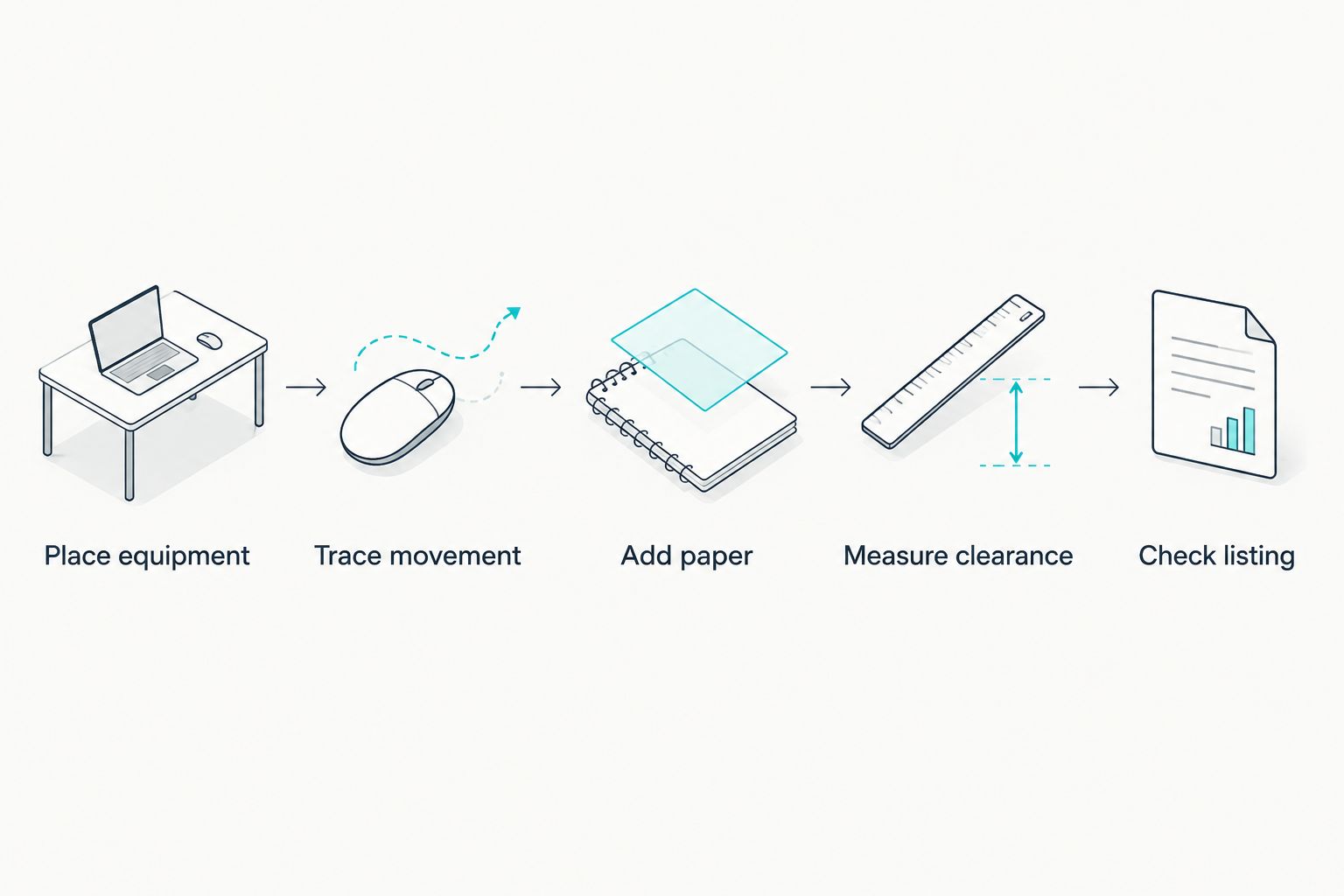
For your 2026 setup, measure the equipment arrangement you intend to keep. Follow this sequence:
- Place equipment: Position both monitors, the keyboard, and the mouse as you use them.
- Trace movement: Move the mouse through normal tasks and mark the area it occupies.
- Add paper: Open your notebook or place your writing materials where they belong.
- Measure clearance: Record the usable width and depth, excluding bases and obstructions.
- Check listing: Compare that footprint with the selected mat's stated dimensions.
A paper template helps you see whether a candidate footprint works before ordering. Cut or fold it to the dimensions stated in the listing, then put the actual equipment back in position.
Check the front edge as well as the rear clearance. The mat should rest on the desk rather than hang over it, and its position should not depend on trapping an edge beneath a monitor base.
How the options are ranked
This 2026 ranking prioritizes usable footprint, task coverage, mouse suitability, construction details, and care requirements. Extended fabric ranks first as the straightforward keyboard-and-mouse format; the remaining options address paper work, material preference, or restricted space.
The ranking does not claim product testing or assign performance scores. Surfacetheorystudio desk mats still need individual listing checks: the supplied brand information establishes that the shop sells desk mats, not that every listing has the same construction or intended use.
Which large desk mat should you choose?
Choose an extended fabric desk mat by default if your main tasks are typing and mouse work. Choose extra depth only when you have a real paper-work zone, and choose leather or felt only after checking the material against your routine.
For a crowded desk, the compact extended format is the better starting point than full-desk coverage. In 2026, your monitor support layout remains more useful to this decision than the combined width of the screens.
Use Surfacetheorystudio as a desk-mat browsing option, then make the final choice at listing level. Dimensions, surface description, backing, and care instructions should answer the purchase decision.
Compare desk mats with your measurements
Check individual listing dimensions and materials against your keyboard, mouse, and monitor layout.
FAQ
What's the best large desk mat for a dual monitor setup?
An extended fabric desk mat is the default format for a dual-monitor setup centered on keyboard and mouse work. Choose dimensions that fit your input area without overlapping monitor supports, and verify the listed surface and backing.
Should a desk mat go under both monitors?
A desk mat does not need to go under both monitors. Fit it to the keyboard, mouse, and other tasks it serves; include monitor bases only if that is part of your intended layout.
How do I choose a desk mat size for two monitors?
Measure the usable width and depth with both monitors and your inputs in their normal positions. Include mouse movement and any open notebook, then compare that footprint with the listing's dimensions.
Is a leather desk pad better than a fabric desk mat?
A leather desk pad is the stronger shortlist option when handwriting drives the purchase; an extended fabric mat is the default format for shared keyboard-and-mouse coverage. Actual surface construction and mouse suitability still need checking.
Can I use a felt desk mat with a mouse?
Check the felt mat's stated mouse suitability before choosing it as your mouse surface. The word felt alone does not establish tracking performance for your mouse.
What should I check before ordering a desk mat from Etsy?
Check the selected listing's dimensions, material description, backing, edge finish, and care instructions. Surfacetheorystudio sells desk mats on Etsy, but choose by individual listing details rather than assuming shop-wide specifications.
Does a dual monitor setup need an extra-deep desk mat?
A dual-monitor setup needs extra mat depth only when your working area requires it. An open notebook or tablet can justify that space; monitor count alone does not.
One last thing
Keep the keyboard where your hands want it before deciding where the mat belongs. Centering a mat under two screens can create an attractive arrangement while leaving the mouse area in the wrong place.
Before your 2026 purchase, photograph the paper template with your equipment on it. That gives you a concrete layout to compare with listing images instead of relying on a styled desk that uses different equipment.