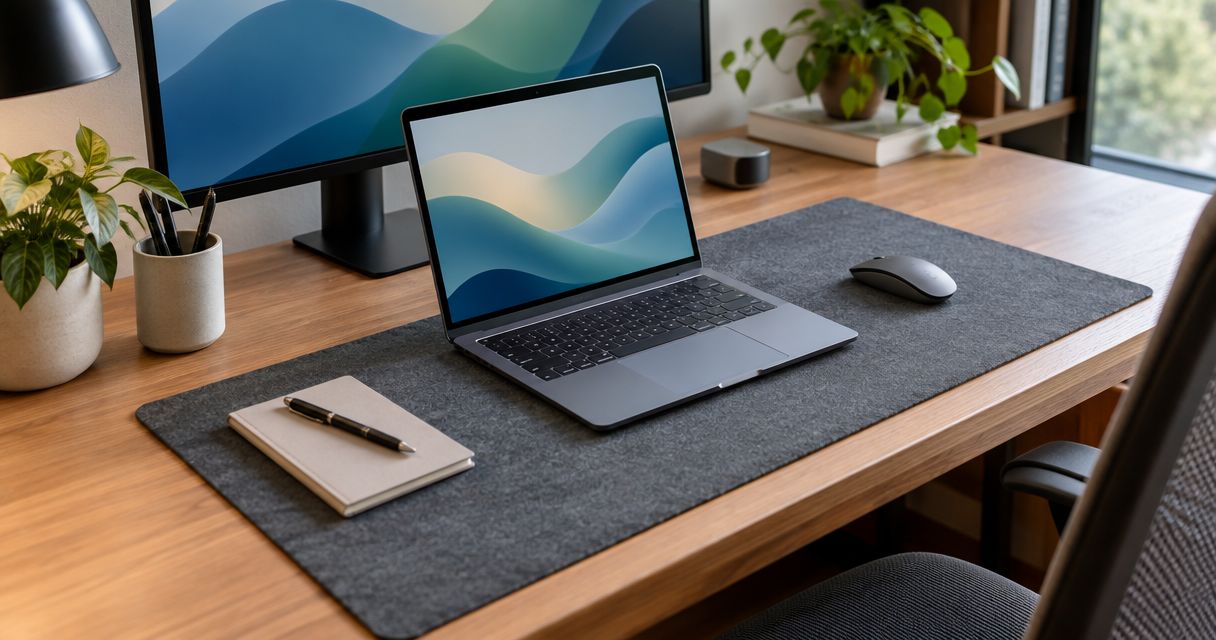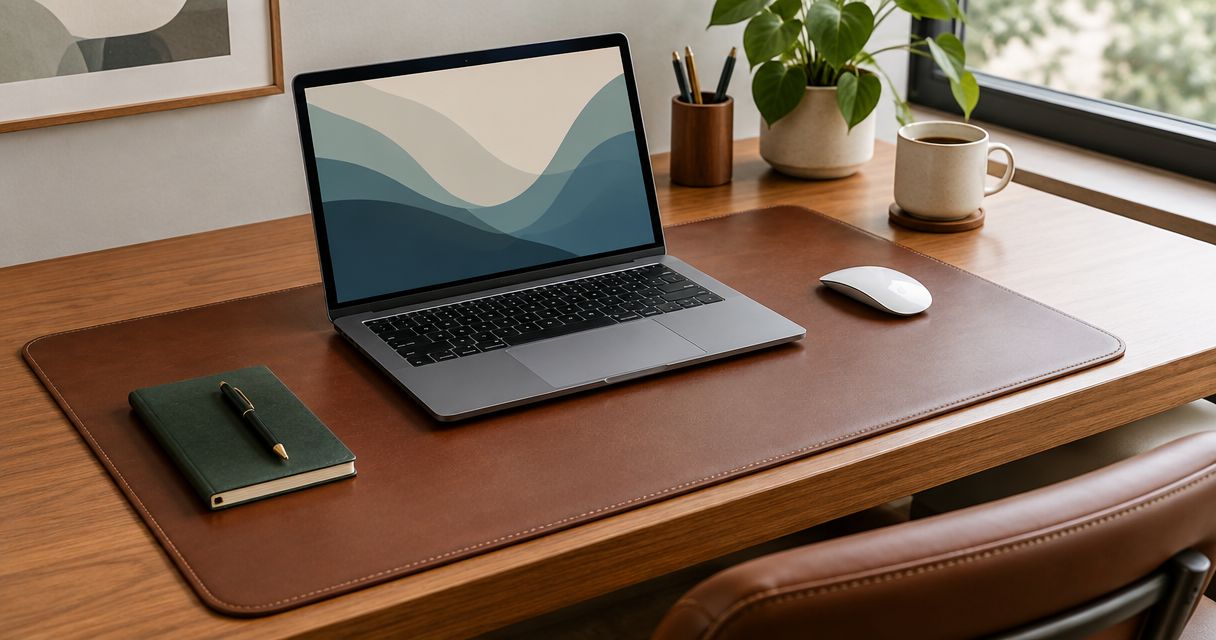
Best overall: a full-grain leather desk pad for daily use. Best for a smoother writing surface: corrected-grain leather. Best for a soft, matte feel: suede. Best for someone considering a lower-commitment leather option: bonded leather, but only after checking its construction. This guide compares material types, not verified products. Surface Theory Studio sells desk mats on Etsy; check an individual listing’s material before treating any of its mats as a leather pick.
- Best leather desk pads 2026: choose full-grain leather for a daily-use pad when you want the natural grain intact.
- Choose corrected-grain leather when a smoother, more uniform surface matters more than visible grain variation.
- Choose suede for feel, but expect its textured surface to demand more care around spills.
- Surface Theory Studio sells desk mats; verify a listing’s material before buying one specifically for leather.
Why this matters
A leather desk pad is both a work surface and an object you touch throughout the day. The finish affects how a pen moves, how the surface feels under your hands, and what happens when you set down a drink. A photograph rarely settles those questions.
The phrase leather desk pad also covers materially different constructions. Full-grain leather retains its natural grain surface. Corrected-grain leather has a more processed surface. Suede has a napped finish, while bonded leather combines leather fibers with binding materials. Those distinctions make a better starting point than color or a product title.
The best leather desk pad in 2026 is the one whose material and construction fit your work, not the one with the broadest leather claim. Start with how you use the desk, then inspect the listing for the details that support that choice.
What makes the best leather desk pad
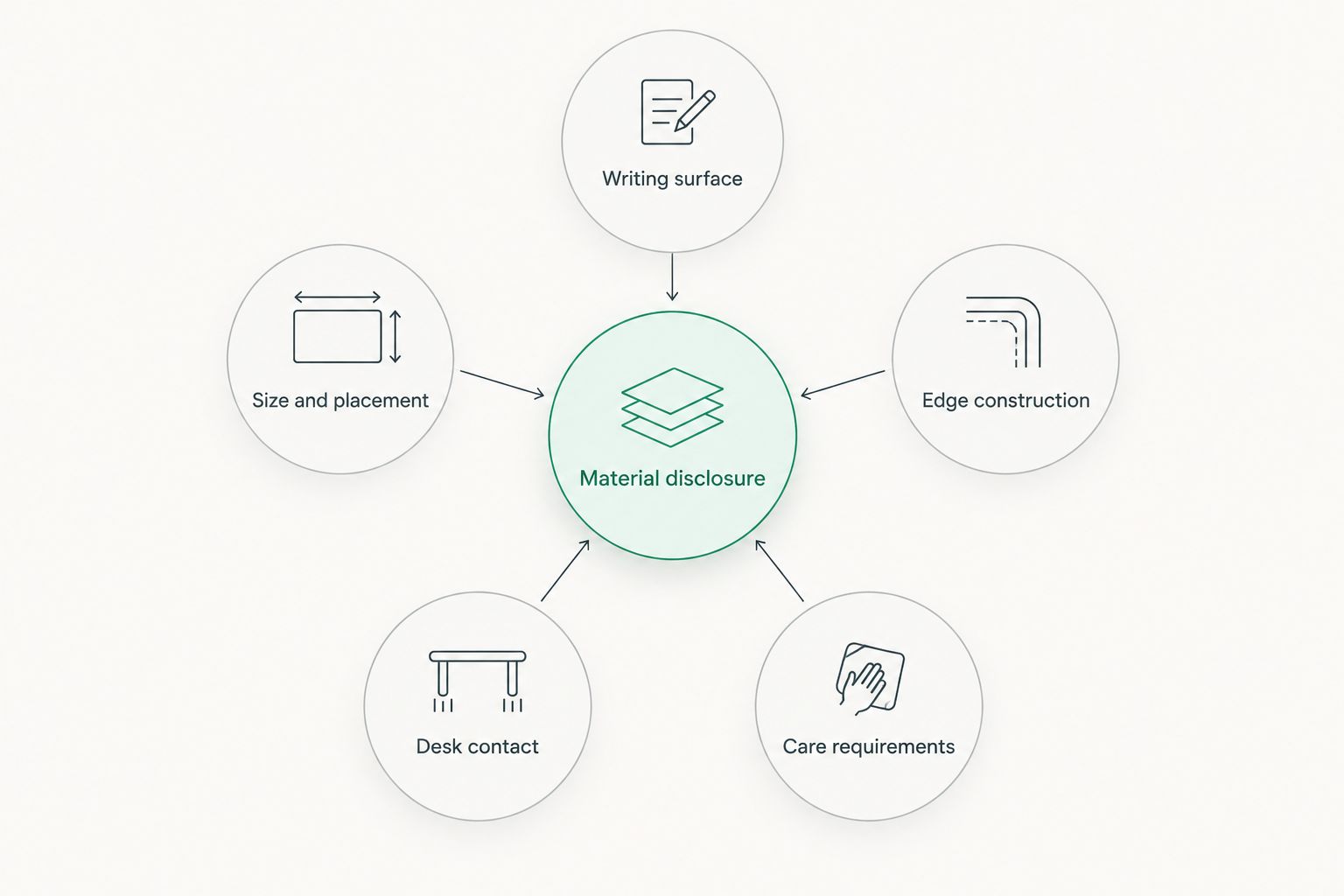
Use these criteria before comparing listings. They explain the ranking and give you a way to reject a pad that looks right but does not suit your desk.
- Material disclosure: Look for a specific description of the leather and any backing. A listing that says only leather leaves the construction unclear.
- Writing surface: Decide whether you want visible grain, a smoother finish, or a soft nap. If you write on single sheets of paper, the surface beneath them matters.
- Size and placement: Measure the equipment that needs to sit on the pad. If your measured keyboard is 18 inches wide and the pad is 24 inches wide, centering it leaves 3 inches on each side.
- Edge construction: Check whether edges are cut, finished, stitched, or folded. The edge is where your forearms and desk accessories repeatedly meet the pad.
- Desk contact: Check whether the listing describes a backing or other underside treatment. Do not assume a leather top tells you how the pad will sit on your desk.
- Care requirements: Match the finish to your habits. A desk where drinks are routine calls for a different care decision from a desk used only for typing.
A measurement sketch is more useful than guessing from a styled photograph. Mark the pad’s proposed footprint on your desk, then check that your keyboard, mouse movement, and writing area fit without crowding the edge.
Leather desk pads at a glance
| Material | Best for | Standout feature | Key limitation |
|---|---|---|---|
| Full-grain leather | A daily-use pad with visible natural grain | Retains the original grain surface | Natural marks and variation are part of the look |
| Corrected-grain leather | A smoother, more uniform work surface | A more even-looking finish | Processing can obscure the original grain |
| Suede leather | A soft, matte desk surface | Distinctive napped texture | The nap takes more care around spills and marks |
| Bonded leather | A buyer willing to inspect composition closely | Uses leather fibers in a manufactured material | The label alone reveals little about the finished pad |
These are material categories, not four interchangeable versions of the same product. In 2026, use the table to narrow your preferred surface, then verify the construction of the particular pad you intend to buy.
1. Full-grain leather: best leather desk pad for daily use
Full-grain leather keeps the original grain surface rather than having it sanded away to create a uniform face. It is the default pick if you want a leather desk pad that visibly remains leather, including its natural variation. Best overall does not mean best for every desk: if you want an exceptionally even appearance, start with corrected-grain leather instead.
For daily typing and writing, judge the complete pad rather than the leather name alone. Thickness, backing, edge treatment, and finish affect the experience, and full-grain does not specify any of them. Ask whether the listed dimensions leave space for your actual mouse movement and whether the surface works for the kind of writing you do.
Full-grain leather pros:
- The original grain remains visible.
- Natural variation gives you a clear way to distinguish its appearance from a heavily corrected surface.
- It suits a buyer who values the leather surface itself over a perfectly uniform finish.
Full-grain leather cons:
- Natural marks and color variation can disappoint you if you expect identical-looking pads.
- The material name does not confirm the backing, finish, or edge construction.
- Surface texture deserves a closer look if you routinely write on single sheets.
Best for: A buyer who wants natural grain on a pad used throughout the workday.
Verdict: Buy a full-grain leather pad when its listing clearly describes the whole construction and its dimensions fit your desk. Otherwise, hold the purchase until those details are clear.
2. Corrected-grain leather: best for a uniform surface
Corrected-grain leather has a surface that has been worked to change or even out the original grain appearance. That makes it the more direct choice when you prefer a consistent-looking desk surface to visible natural variation. It is still leather, but the degree and type of surface treatment matter.
Do not treat corrected grain as a complete performance specification. A smooth-looking photograph cannot tell you how a finish feels under your hand or how the pad is backed. Read the material description and inspect close-up photographs of the surface and edges before deciding whether the more uniform look is what you want.
Corrected-grain leather pros:
- A more even appearance suits a visually restrained desk setup.
- Surface treatment gives you an alternative to the pronounced variation of full-grain leather.
- It offers a clear use case for buyers who prioritize a smoother-looking face.
Corrected-grain leather cons:
- Processing reduces the visibility of the original grain.
- Listings may not explain how the surface was finished.
- A uniform appearance alone does not establish how the pad handles writing or desk contact.
Best for: A buyer who wants leather with a smoother, more consistent appearance.
Verdict: Buy when the listing identifies the material and shows the surface clearly. Hold if the only evidence of construction is a distant desk photograph.
The full-grain versus corrected-grain choice is not a contest between authentic and inauthentic leather. It is a decision about which surface you want to see and use every day. In 2026, make that decision before comparing colors.
3. Suede leather: best for a soft, matte feel
Suede is leather with a napped surface. It feels and looks different from a smooth-grain desk pad, which makes it a distinct choice rather than a substitute selected on color alone. The texture is the reason to buy it—and the reason to think carefully about your desk habits.
If you keep drinks, pens, and loose sheets on the same surface, consider how much attention you want to give the pad. A napped finish makes marks and changes in texture more noticeable than they would be on some smoother surfaces. Check the seller’s stated care guidance for the specific pad rather than applying a generic leather-cleaning routine.
Suede leather pros:
- Its soft, napped surface has a feel unlike smooth-grain leather.
- A matte appearance suits a buyer who does not want a polished-looking pad.
- Its texture makes the material choice immediately apparent in use.
Suede leather cons:
- The nap calls for more deliberate care around spills and marks.
- Texture can affect how paper and small accessories move across the surface.
- It is a poor blind purchase if you have not considered upkeep.
Best for: A buyer who puts tactile feel first and is prepared to follow the pad’s care instructions.
Verdict: Buy for the nap, not merely because the listing says leather. Skip suede when you need a surface you can treat without thought during a busy workday.
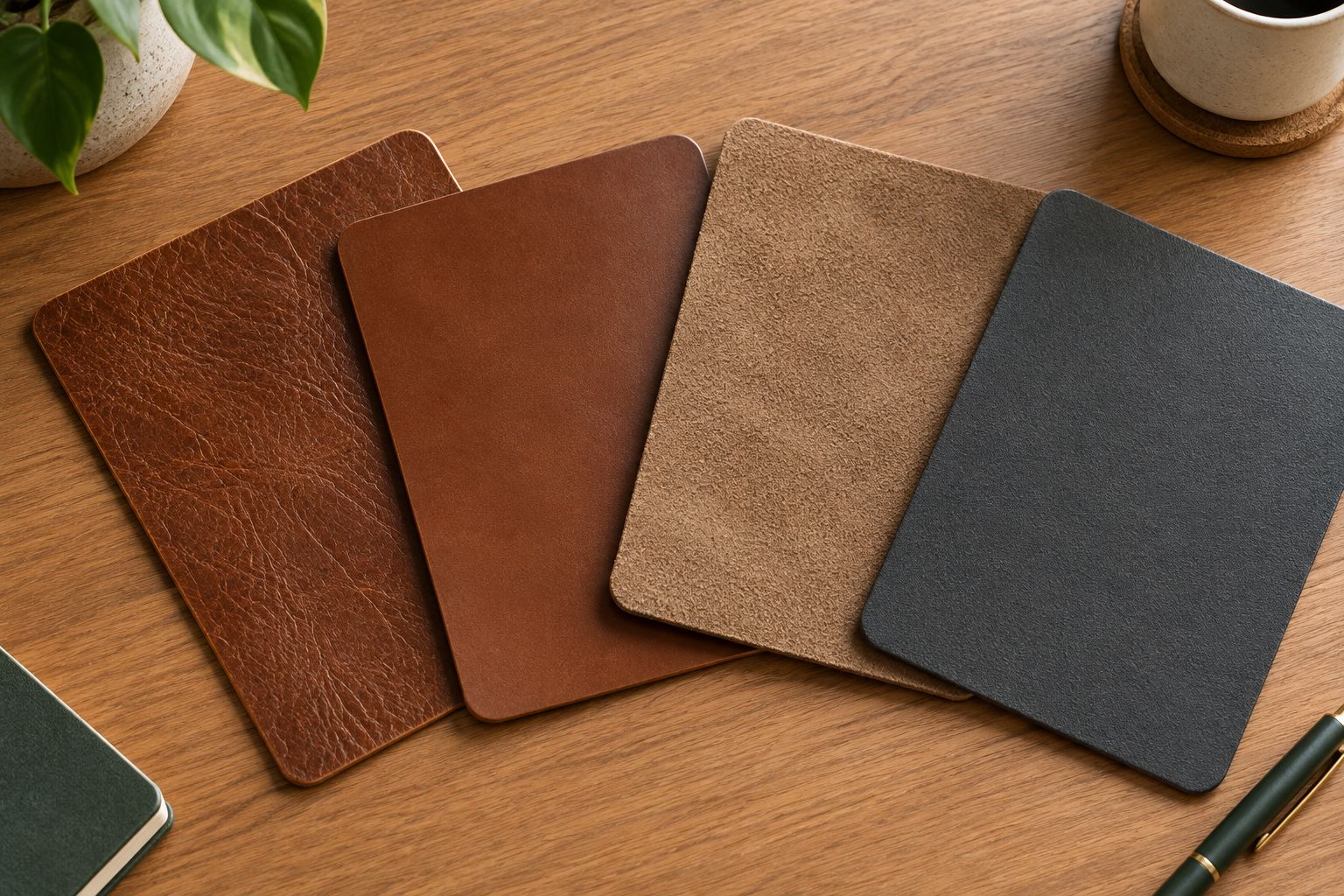
4. Bonded leather: best for a buyer checking composition
Bonded leather is a manufactured material made with leather fibers and binding substances. The term tells you something about its ingredients, but not enough about the surface, backing, or how a finished desk pad is assembled. It ranks last because its name demands the most follow-up before you can judge a specific listing.
If a bonded-leather pad appeals to you, ask what the exposed surface is and how the material is constructed. Compare those answers with a close-up image of the pad and its edge. Do not assume that a bonded-leather listing offers the same surface experience as full-grain or corrected-grain leather.
Bonded leather pros:
- It gives you another material construction to consider if natural grain is not your priority.
- A clear composition description lets you judge the pad on its actual construction.
- It can be assessed against the same size, edge, and backing criteria as the other options.
Bonded leather cons:
- The category name does not identify what you will touch on the finished pad.
- Construction can be difficult to evaluate from a distant photograph.
- It is not an equivalent choice for someone specifically seeking an intact natural grain surface.
Best for: A buyer who is willing to verify the composition and wants the finished construction, not the leather label, to drive the decision.
Verdict: Hold until the listing explains the surface and backing. Skip it if your reason for shopping is the natural grain of leather.
How the ranking works
The 2026 ranking starts with material identity, then considers how clearly each type serves a different desk use. Full-grain takes the default slot because its defining feature—the retained grain—directly answers a buyer looking for a natural leather surface. Corrected grain serves the buyer seeking a more uniform finish; suede serves a tactile preference; bonded leather requires a closer composition check.
This is a material ranking, not a claim that every full-grain pad outperforms every corrected-grain pad. A well-described pad of your second-choice material is a better purchase than a vaguely described pad of your first-choice material. Check the full listing before making the final call.
Surface Theory Studio is a desk-mat seller, but no specific Surface Theory Studio mat is ranked here as a leather product. If you are considering one of its listings, apply the same material, size, edge, backing, and care checks. The seller’s category does not establish a particular mat’s composition.
Which leather desk pad should you choose?
Choose full-grain leather as the default in 2026 if you want the original grain to remain visible and are comfortable with natural variation. Choose corrected-grain leather if a more uniform surface is the priority. Choose suede only when its soft nap is the point of the purchase; treat bonded leather as a construction to verify, not a shortcut to a full-grain look.
Before ordering, measure the working area rather than the whole desk. Place your keyboard where you actually use it, move the mouse through its normal range, and mark the space reserved for writing. Leave the clearance you need at the front and sides. A pad that looks generous in isolation can feel cramped once your equipment is in place.
If you are shopping Surface Theory Studio desk mats, read the individual Etsy listing to establish whether a mat is leather at all. Then use the criteria above to decide whether it belongs on your shortlist. A confirmed material and a workable footprint beat an attractive photograph.
FAQ
What's the best leather desk pad in 2026?
A full-grain leather desk pad is the best default for a buyer who wants the natural grain intact. Check its backing, edge construction and dimensions before choosing a specific pad.
Is full-grain leather better than corrected-grain leather for a desk pad?
Full-grain leather is better if visible natural grain is your priority; corrected-grain leather is better if you prefer a more uniform-looking surface. Neither material name tells you everything about a finished pad.
Is suede a good material for a desk pad?
Suede is a good choice if you want a soft, matte, napped surface and are prepared to follow its care instructions. Its texture makes spills and marks a more important consideration.
Is bonded leather the same as full-grain leather?
No. Bonded leather uses leather fibers and binding substances, while full-grain leather retains the original grain surface. Check a bonded-leather listing for its finished surface and construction.
How do I choose a leather desk pad size?
Measure the space used by your keyboard, mouse movement and writing before choosing a pad. Mark the proposed footprint on your desk so you can check clearance at each edge.
Does Surface Theory Studio sell leather desk pads?
Surface Theory Studio sells desk mats on Etsy, but a specific leather material is not established here. Check the material details of the individual listing before treating a mat as a leather option.
What should I check before buying a leather desk pad online?
Check the stated material, dimensions, edge construction, backing and care guidance. Close-up photographs of the surface and edges help you assess details that a styled desk image cannot show.
One last thing
Check the underside before deciding on the top. The leather description tells you what the visible material is; it does not tell you how the finished pad contacts your desk. In 2026, make backing and edge details part of the buying decision, whether you are considering Surface Theory Studio or any other desk-mat seller.